

I wasn’t letting my son watch TV, and I was casting around for something that felt at least a little more productive. So I suggested we make a video game. Twenty minutes later we’d actually made one, and my entire creative contribution was the keyboard.
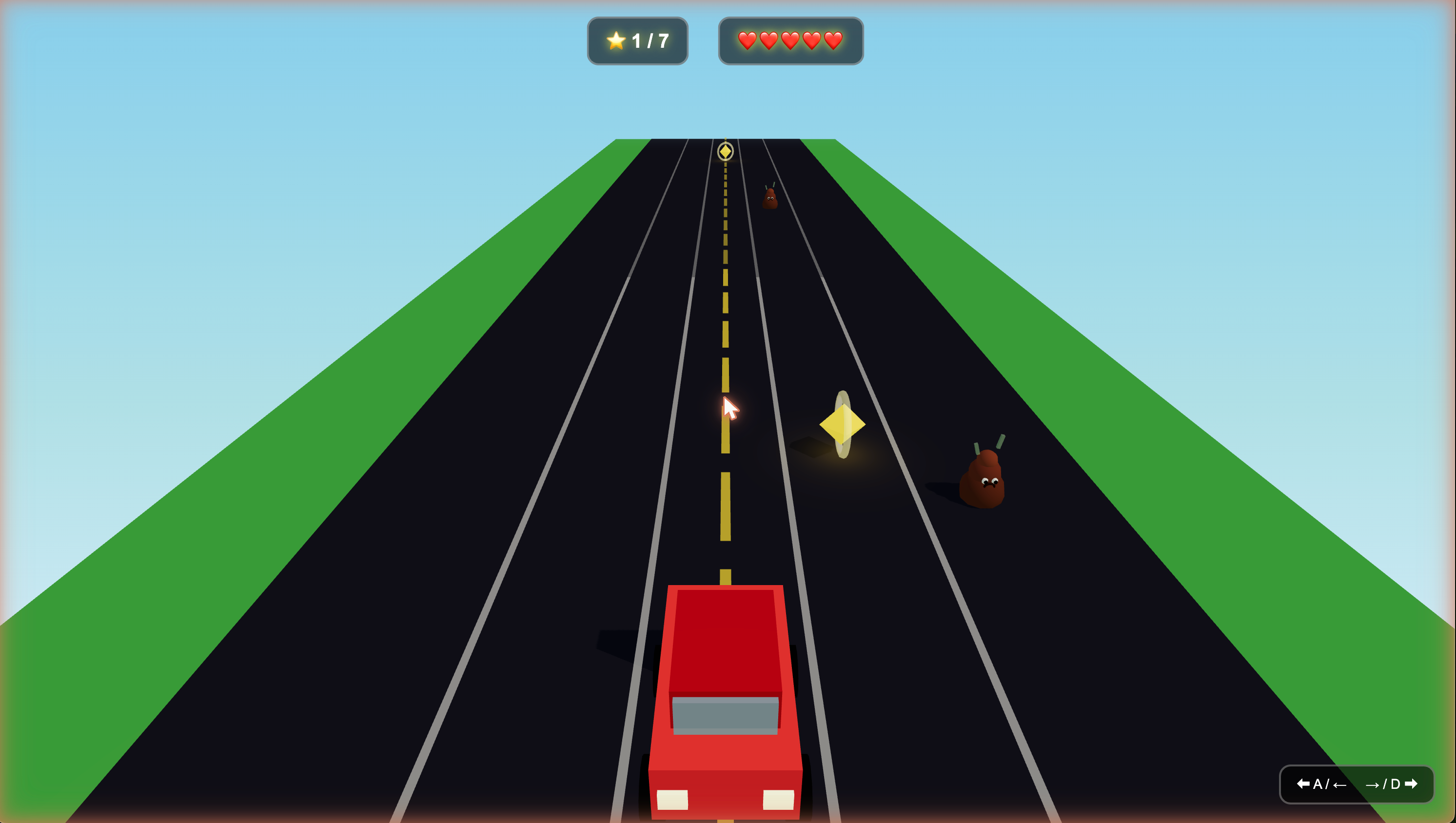
It’s called Poop Dodge. I won’t oversell the premise—it’s a 3D racing game where you steer a little red car down a six-lane highway, dodging piles of poop and grabbing stars, and you win when you’ve collected seven. We built it in Replit, one of those AI coding tools where you describe what you want in plain English and it writes the actual code. He doesn’t type fast yet, so the deal was simple: he designed, I typed.
How easy it actually is
Here’s the very first thing we typed in, more or less word for word from him:
Build a racing game where users try to avoid poop (cartoonish or emoji-like) in the road and collect stars. After players collect 10 stars, they win! And there’s a big celebration
That was it. A few seconds later there was a playable game on the screen. No setup, no install, no semicolons. From there, the whole thing was just him reacting to what he saw and telling it what to change:
“I think the road is vertical instead of horizontal”
“whenever there’s a poop now, it should cover 2 lanes and only have one opening for the car”
“Let’s have six lanes and three poops at every row where there’s poop”
“driven at night” … then thirty seconds later … “Actually, let’s have the car driving in the morning time”
“Make this playable on mobile”
Every one of those did exactly what it says. The morning lighting, the six lanes, the touch controls for his tablet—all of it, from a kid talking out loud while I typed.
He really did design it
That first line up there, “I think the road is vertical instead of horizontal,” is the one that got me. That’s debugging. He looked at the screen, knew it was wrong, and described the fix—he just needed me to type it. (To be fair, he did not use the words “vertical” or “horizontal). I didn’t tell him any of that. The judgment was entirely his.
The star count was the same story. He kept changing his mind: 10 to win, then 30, then 100, then back down to 5, then 7. He wasn’t guessing—he was playing each version and deciding whether it felt too easy or like a slog. That’s game balancing. He’s six.

We didn’t have this
I keep thinking about that. I learned C in college, and even there—no magazine, just me and a text editor—a single missing semicolon could blow up the whole program and leave me squinting at it for an hour. Most of the effort went into fighting the syntax, not the idea. My son skips all of that. The friction that ate my time is just gone for him, and what’s left is the part that was always the good part: deciding what to make.
The skill that’s left
I think that’s the actual lesson for those of us raising kids right now. The hard-won skill used to be telling the machine how to do something, and that’s the part the AI does pretty well now. What it can’t do is decide what’s worth making, notice when something feels wrong, or know that 100 stars is a slog and five is too easy. That’s taste, and it turns out my kid has plenty of it.
So I don’t think he “didn’t really make it” because he didn’t write the code. He made every decision that mattered. I was labor.
He already wants a sequel with enemies that chase you, which means I should go figure out how that works before tomorrow night. The creative director has notes.
If you’ve got a kid and a free evening, try it—let them design, you type. You might be surprised who’s running the meeting.
AJ, I did the 16yo version of this a few weeks ago. After the AP test, we spent a week vibe coding. School didn’t have replit so it was all Gemini code/netlify hosted. Initially I carefully crafted prompts to make sure they got something functional. But by the end of the week I realized some of the best apps were build when they went freestyle. Your son will be an AI-native. Huh, what do you think of that?
Here’s my kids gallery: https://analynet.xyz